
For many European companies, Asia-Pacific (APAC) has become one of the world’s most attractive regions for international expansion. Rapid economic growth, a rising middle class, digital transformation, and diversified supply chains continue to create new opportunities across industries. However, entering a new market is rarely just about having a great product or service.
One of the biggest challenges businesses face is finding the right local partners. Successful international expansion depends on more than market demand. It requires trusted relationships, local knowledge, and partners who understand how business is conducted on the ground. Without these foundations, even the most promising expansion plans can become costly and time-consuming.
The good news is that businesses no longer need to build everything from scratch. Depending on their objectives and stage of expansion, companies can choose different partnership models to reduce risk, accelerate market entry, and create sustainable growth.
This guide explores five of the most effective partnership models used by businesses expanding between Europe and the Asia-Pacific region.
1. Market Research Partnerships
Building Decisions on Insights, Not Assumptions
Every successful expansion begins with understanding the market.
Before approaching distributors or investing in marketing campaigns, companies should first answer a few fundamental questions:
- Is there genuine demand for our product or service?
- Who are our competitors?
- How is the market structured?
- What regulations should we be aware of?
- Which customer segments should we target?
A market research partner helps businesses gather reliable information, validate opportunities, and identify potential challenges before significant investments are made.
This reduces uncertainty and allows companies to develop strategies based on evidence rather than assumptions.
A good fit for:
- Businesses entering APAC for the first time
- Companies evaluating multiple markets
- Investors assessing commercial opportunities
2. Business Matching
Finding the Right Partner, Not Just More Contacts
Networking events often generate dozens of business cards.
Business matching aims to generate meaningful business conversations.
Rather than introducing companies to as many organisations as possible, business matching focuses on identifying qualified partners whose capabilities, goals, and interests align with the company’s objectives.
Potential partners may include:
- Distributors
- Manufacturers
- Investors
- Suppliers
- Technology partners
- Strategic collaborators
Quality introductions save time and significantly improve the likelihood of building productive long-term relationships.
The objective is not simply to arrange meetings but to create opportunities where both parties see genuine commercial value.
3. Joint Marketing Partnerships
Building Market Visibility Together
Entering a new market often means starting with limited brand awareness.
Instead of building visibility alone, many international businesses collaborate with local organisations through joint marketing initiatives.
These collaborations may include:
- Industry seminars
- Business forums
- Trade exhibitions
- Webinars
- Co-branded content
- Digital campaigns
- LinkedIn thought leadership
Joint marketing enables both organisations to leverage each other’s reputation, audience, and market presence.
For companies entering APAC, this approach often creates credibility much faster than traditional advertising alone.
Trust is built more effectively when local organisations are willing to stand alongside international partners.
4. Distribution Partnerships
Accelerating Market Access Through Local Networks
For product-based companies, building an internal sales network from day one is rarely the most efficient option.
Instead, many businesses partner with local distributors who already possess:
- Established customer relationships
- Sales teams
- Logistics capabilities
- Technical support
- Industry expertise
A strong distribution partner provides immediate access to the market while helping businesses navigate local purchasing behaviour and commercial practices.
However, selecting a distributor should never be based solely on company size.
The most valuable partnerships are built on strategic alignment, transparent communication, shared expectations, and long-term commitment.
5. Local Representation
Establishing a Presence Without Opening an Office
Opening a local office requires considerable investment, time, and operational resources.
For many businesses, local representation offers a practical alternative during the early stages of market expansion.
A local representative can support activities such as:
- Business development
- Partner engagement
- Market intelligence
- Event participation
- Meeting coordination
- Follow-up with prospective clients
- Cross-cultural communication
This model enables businesses to maintain an active presence in the market while remaining flexible and cost-efficient.
As opportunities grow, companies can then determine whether establishing a permanent office becomes commercially viable.
Choosing the Right Partnership Model
One question we often hear from businesses is:
“Which partnership model should we start with?”
The answer is usually another question:
“What are you trying to achieve?”
If you’re still unsure whether a market is right for your business, market research should come first. If you’ve already validated the opportunity but don’t know who to work with, business matching is often the next logical step. Once you’ve found the right partner, joint marketing can help both businesses gain visibility and build trust in the local market. As sales begin to grow, distribution partnerships or local representation may become the natural next stage.
We’ve learned that successful international expansion rarely follows a perfect roadmap. Every company enters a market with different goals, resources, and timelines. That’s why the most effective partnership strategy isn’t about choosing one model over another—it’s about knowing which one will create the most value at each stage of your journey over the others—they’ll build a strategy that integrates all three. This is the perspective Ronin believes will shape the future of digital visibility.
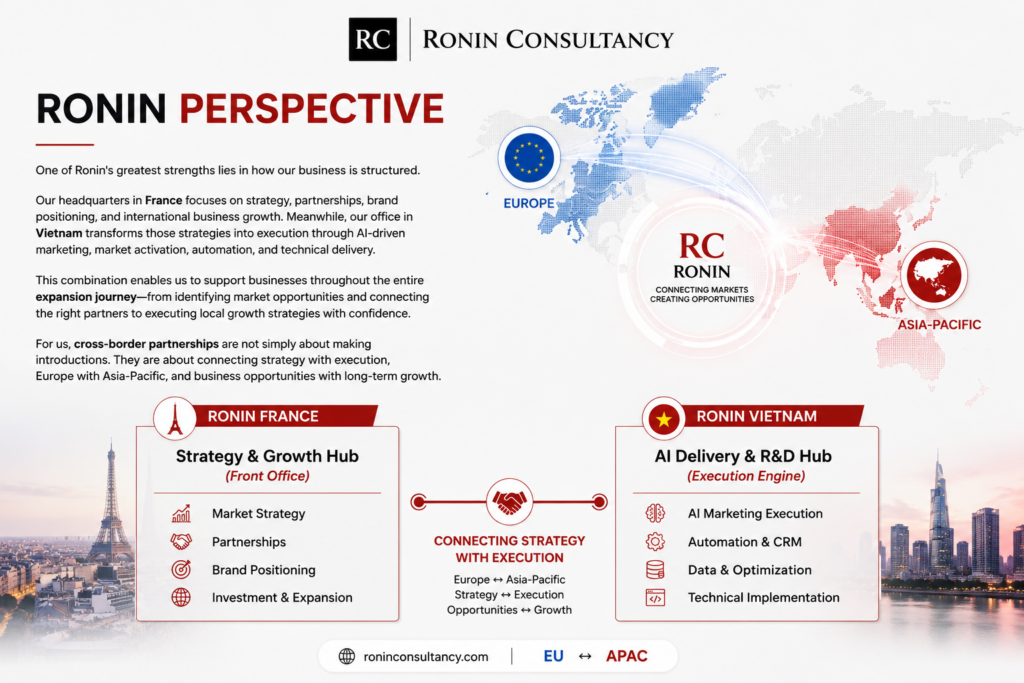
Ronin Perspective