
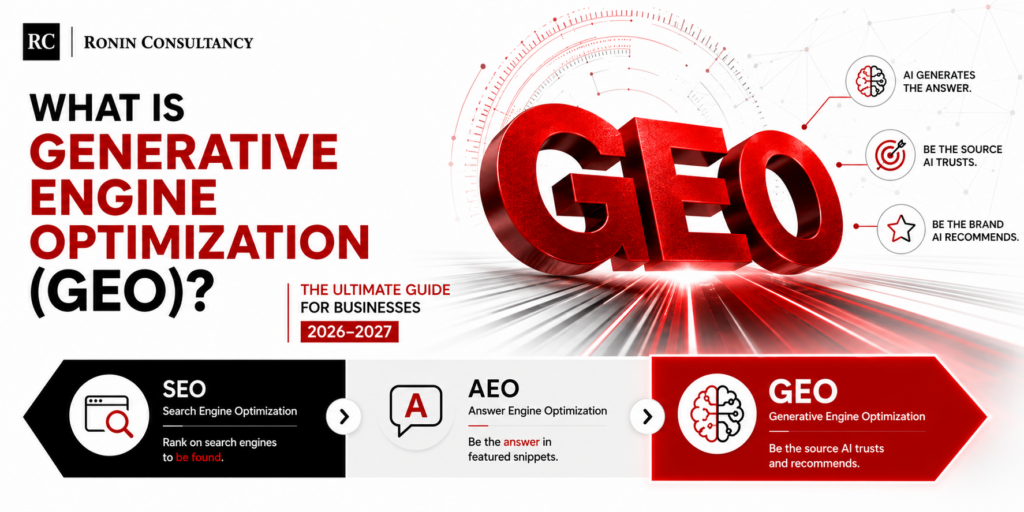
Search Is Changing Again
For more than two decades, businesses have invested heavily in one goal: being found online. The strategies have evolved over time, but the objective has remained remarkably consistent—be visible when customers are looking for solutions. Today, however, the way people discover businesses is changing once again. Customers no longer rely solely on Google. They ask Chat GPT for recommendations, read AI-generated summaries, compare opinions on Reddit, and validate decisions through social communities before contacting a company.
This doesn’t mean SEO is becoming obsolete.
It means digital visibility is no longer built on a single strategy.
Today, businesses need to think about SEO, AEO, and GEO together.
The First Era: SEO (Search Engine Optimization)
For years, SEO has become the cornerstone of digital marketing. Its purpose is straightforward: help your website rank higher on search engines when people search for products, services, or information. Businesses invested in:
- Keyword research
- Technical website optimization
- Content marketing
- Backlink building
- Website speed
- User experience
The higher a website ranked, the greater its chance of attracting visitors. So far, SEO remains incredibly crucial because websites continue to be one of the strongest sources of credibility for any business. Not to mention, give the rapid of cross-border investment, the role of searching everything online is more important than ever. As a result, SEO establish a foothold for both start- up companies and long- term co-operations. We have seen a variety of successful stories based on SEO. Let’s take Canva as an shinning example, Canva invested heavily in SEO by creating landing pages for thousands of design-related keywords
Examples include:
- Resume templates
- Business cards
- Instagram posts
- Presentations
- Logos
Consequently, many users discover Canva through Google before ever searching for “Canva”
The Second Era: AEO (Answer Engine Optimization)
If SEO was about helping people find your website, AEO is about helping search engines answer their questions. This shift has become much more visible since Google introduced AI Overviews, where the search engine generates a summary instead of simply displaying a list of links
For example, try searching:
“What’s the difference between SEO and GEO?”
“Best CRM for small businesses”
“How to improve employee retention”
Instead of showing only traditional search results, Google increasingly presents an AI-generated answer at the top of the page, pulling information from multiple trusted sources. For many users, that summary is enough—they never scroll further or click through to another website
This represents a significant change in user behaviour. Businesses are no longer competing solely for rankings; they’re competing to become one of the sources that Google’s AI chooses to reference. That is the core idea behind Answer Engine Optimization (AEO). Companies that publish well-structured content, answer specific questions clearly, and demonstrate expertise are more likely to appear in AI-generated responses. FAQ pages, comparison articles, step-by-step guides, and content written around real customer questions have become increasingly valuable.
The challenge is no longer just:
“Can customers find our website?”
It’s becoming:
“Can Google trust our content enough to use it as an answer?”
The Rise of GEO (Generative Engine Optimization)
If you’ve spoken to business owners over the past year, you’ve probably noticed a subtle change in how people look for information. Instead of searching Google and comparing five or six websites, many are starting with a conversation. They open Chat GPT, Gemini, Claude, or Perplexity and ask questions like:
“Which consultancy can help us enter the Southeast Asian market?”
or “Who has experience organizing business events for European companies in Vietnam?”
The expectation is different. People aren’t looking for a page of search results anymore—they’re looking for a recommendation they can trust. That changes the role of digital marketing. It’s no longer enough for your website to rank well. Your business also needs to be recognised beyond your own website. AI builds its responses by drawing on information from many different places, including industry publications, customer reviews, case studies, expert interviews, community discussions, and other credible sources across the web.
The stronger and more consistent those signals are, the more likely your business is to appear when AI recommends companies in your industry.
In many ways, GEO isn’t about teaching AI what your business does. It’s about giving AI enough evidence that your business is worth recommending
Why SEO, AEO and GEO Are Not Competing Strategies
One of the biggest misconceptions today is that GEO will replace SEO.
We don’t believe that’s true. Instead, these three disciplines work together, each supporting a different stage of how customers discover information.
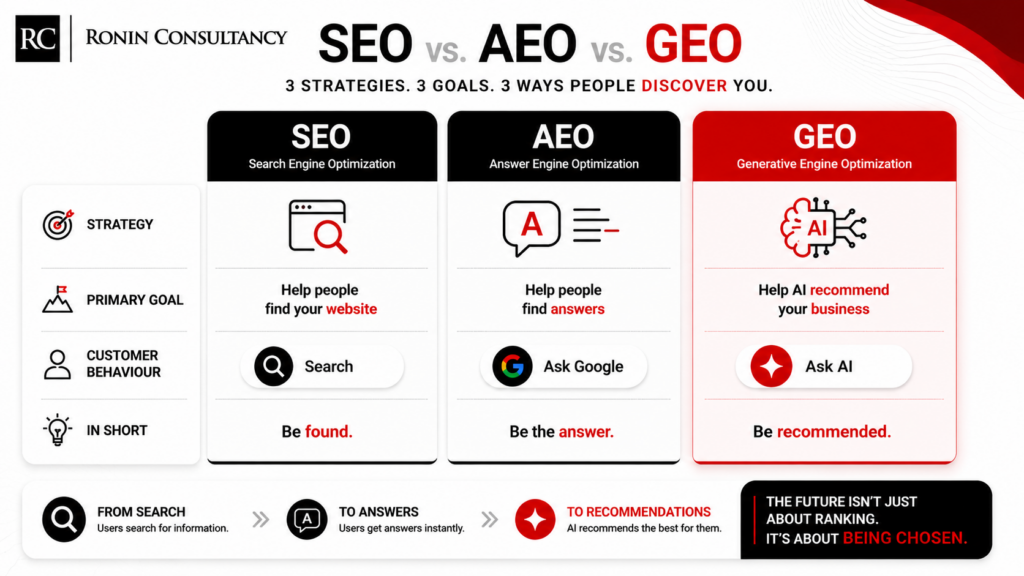
Think about your own behavior for a moment. Sometimes you search on Google. Sometimes you read an AI Overview. And increasingly, you might ask Chat GPT before opening a browser at all. Customers are doing exactly the same thing.
That’s why relying on just one approach is becoming increasingly risky. Visibility today isn’t created by a single tactic. It’s built by showing up consistently wherever people—and now AI—go looking for answers.
Ronin Perspective
These companies didn’t succeed simply because they ranked #1 on Google.
They succeeded because SEO allowed them to become the first place customers learned something valuable.
That trust translated into brand recognition, customer relationships, and long-term business growth.
This is also why SEO remains an essential foundation today. While AI is changing how people discover businesses, search engines still drive billions of queries every day. A strong SEO strategy continues to build the content, authority, and credibility that later support both AEO (Answer Engine Optimization) and GEO (Generative Engine Optimization).
In other words:
SEO helps people find you.
AEO helps people get answers from you.
GEO helps AI recommend you.
The most resilient brands won’t choose one over the others—they’ll build a strategy that integrates all three. This is the perspective Ronin believes will shape the future of digital visibility.