Expanding into Asia-Pacific (APAC) is often described as one of the biggest growth opportunities for international businesses.
And it is.
But here’s the challenge: APAC is not a single market.
The Asia-Pacific region spans more than 40 economies, including major markets such as Australia, New Zealand, Japan, South Korea, China, Hong Kong, Taiwan, Singapore, Malaysia, Thailand, Vietnam, Indonesia, the Philippines, Cambodia, Laos, Myanmar, Brunei, India, and many Pacific nations.
Although these countries are often grouped under one regional label, they differ significantly in business culture, consumer behaviour, purchasing power, regulatory environments, communication styles, and decision-making processes.
A product that stands out in Singapore may need a completely different positioning in Vietnam. A sales approach that works well in Australia could be perceived as too direct in Japan, while a marketing campaign that resonates in Indonesia may not connect with customers in South Korea.
This is why many cross-border expansion strategies struggle—not because the product lacks quality, but because businesses assume one regional strategy will work everywhere. Successful expansion isn’t simply about entering APAC.
It’s about understanding each market within APAC.
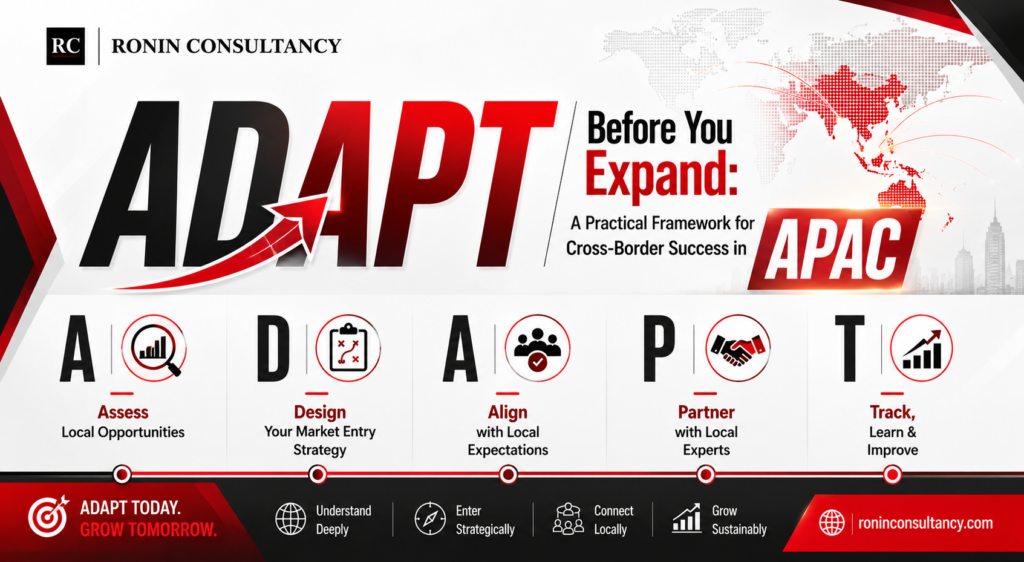
Before you expand, ADAPT.
A — Assess Local Opportunities
Every market has opportunities, but not every opportunity is worth pursuing. Before expanding into a new country, businesses should first understand where demand actually exists, how competitive the market is, and whether their products or services solve a genuine local problem. This assessment should go beyond market size. It should also consider purchasing power, industry maturity, regulatory requirements, distribution channels, and customer behaviour.
For example, a French company manufacturing industrial energy-saving equipment may see strong opportunities in Vietnam, where manufacturers are increasingly investing in energy efficiency to reduce operating costs and meet sustainability targets.
In Japan, however, the opportunity may lie less in introducing new technology and more in offering highly specialised solutions that integrate with existing production systems and meet strict quality standards.
Both markets offer potential—but for very different reasons.
Understanding these differences helps businesses invest in the right market instead of simply the biggest market.
D — Design Your Market Entry Strategy
Once the opportunity has been identified, the next question is how to enter the market.
There is no universal market entry strategy. Some businesses succeed through local distributors. Others benefit from strategic partnerships, representative offices, joint ventures, or direct investment.
The right approach depends on the industry, the product, and the local business environment.
For example, a German software company entering Singapore may choose to establish direct sales operations because customers are familiar with international SaaS solutions and digital procurement processes.
The same company entering Indonesia may achieve better results by partnering with a local technology integrator that already has established relationships with enterprise clients.
Choosing the right route to market is often just as important as choosing the right market itself
A — Align with Local Expectations
Customers do not only buy products.
They buy confidence, relevance, and trust.
That is why successful companies adapt not only their marketing messages but also their customer experience, pricing strategy, communication style, and value proposition to match local expectations.
For example, a European premium skincare brand entering South Korea may highlight product innovation, active ingredients, and scientific research because consumers are highly informed about skincare technology.
In Vietnam, however, customers may pay closer attention to authenticity, product safety, local reviews, and whether the products are suitable for a tropical climate.
The product remains the same. What changes is how its value is communicated.
Businesses that understand these expectations connect with customers much faster than those relying on a one-size-fits-all approach
P — Partner with Local Experts
No matter how experienced a company is internationally, local expertise can significantly reduce the risks of entering a new market.
Local partners understand regulations, business culture, distribution networks, customer behaviour, and potential challenges that may not appear in market reports.
For example, a Dutch company developing smart greenhouse technology may partner with agricultural associations and distributors in Vietnam before launching commercially. Rather than investing heavily from day one, it can organise demonstration workshops, gather feedback from local farmers, and identify the applications that create the strongest interest.
Similarly, a European education institution planning to recruit students in Thailand may collaborate with established education agencies that already understand local parents’ expectations, student preferences, and school networks.
The right local partner does more than open doors. They help businesses avoid costly mistakes
T — Track, Learn & Improve
Market entry is not the final milestone.
It is the beginning of a continuous learning process. Customer expectations change.
Competitors respond.
Economic conditions evolve.
Businesses that monitor performance and adapt quickly are far more likely to succeed in the long term.
For example, an Australian professional training provider entering Malaysia may initially promote internationally recognised certifications.
After several months, customer feedback may reveal that employers are more interested in flexible corporate training programmes and practical workplace outcomes than certification alone.
Likewise, a European food manufacturer entering Japan may discover that smaller packaging, clearer product information, or in-store tasting events significantly improve customer acceptance.
Listening to the market and making continuous improvements allows businesses to grow sustainably rather than relying on assumptions made before launch
Markets don’t expand businesses. People do.
Behind every successful cross-border investment is a deep understanding of local markets, trusted partnerships, and strategies that respect cultural differences.
That’s the idea behind the ADAPT Framework.
Assess. Design. Align. Partner. Track.
Before you expand, ADAPT.
At Ronin Consultancy, we bridge businesses between Europe and Asia-Pacific (APAC) by combining strategic insight with local execution.
Whether it’s conducting Market Research, developing Strategic Marketing plans, connecting businesses through Business Matching, supporting Events & Expos, or driving Local Business Development, our goal is the same:
To help businesses enter new markets with greater confidence, lower risk, and stronger long-term partnerships.