
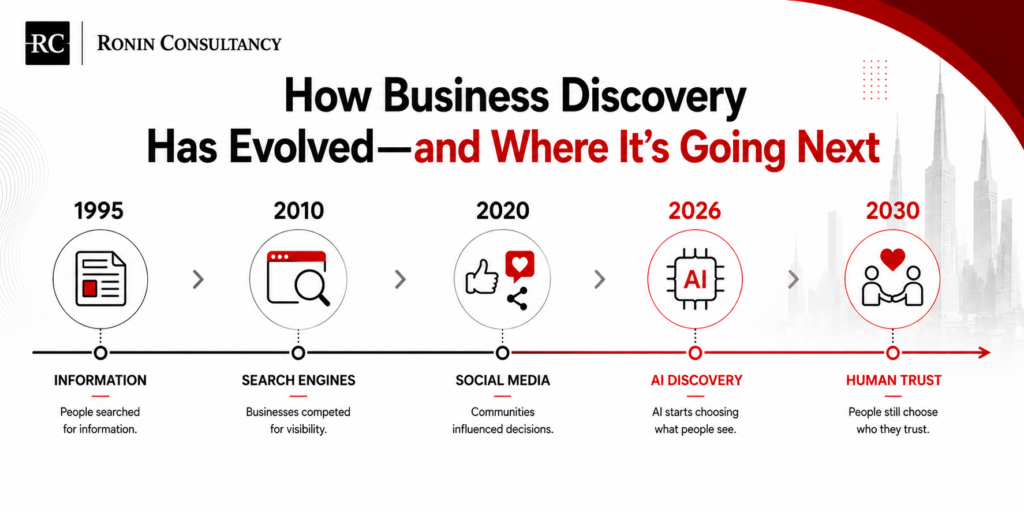
For years, businesses have asked the same question: “How do we get discovered?” The answer has never stayed the same.
In the late 1990s, simply having information online was enough. A decade later, success depended on ranking on Google. Then social media reshaped how people discovered brands, turning algorithms and communities into powerful decision-makers. Today, another shift is underway. People are beginning to ask AI before they ask Google. Instead of browsing ten websites, they expect one intelligent answer.
This doesn’t mean SEO is dead or social media no longer matters. It simply means the journey from discovery to decision is changing again.
Looking back, every major technological wave has changed how businesses are found.
Looking ahead, the next competitive advantage may not be another platform or another algorithm.
It may be something far more difficult to automate: Human trust
1995: Information
It’s easy to forget how different the internet looked in the 1990s. There were no social media feeds, no AI assistants, and Google was still in its early days. For many businesses, launching a website was considered a major step forward. Customers weren’t expecting interactive experiences or polished content. They simply wanted a place where they could learn who you were, what you offered, and how to get in touch.
In other words, being online was often enough. The challenge wasn’t competing for attention—it was making sure people could find you at all
2010: Search Engines
As the internet continued to grow, simply having information online was no longer enough. Millions of websites were competing for the same audience, and attention quickly became the most valuable resource.
That’s when Google changed the game.
For the first time, businesses weren’t just trying to exist online—they were competing to be found first. Appearing on the first page of search results could generate a steady flow of customers, while being buried on page two often meant being invisible. This was also the period when SEO evolved into a core business strategy rather than just a technical task. Companies invested heavily in content, keyword research, backlinks, and website performance because every improvement could mean more visibility, more traffic, and ultimately more revenue.
For many businesses, success came down to one simple question:
“Where do we rank on Google?”
2020: Social Media
By the early 2020s, discovery had expanded well beyond search engines. Consumers increasingly relied on social platforms and online communities to evaluate brands before making decisions. A recommendation from a LinkedIn connection, a TikTok creator, or a discussion on Reddit often carried as much influence as a high Google ranking.
This marked a significant shift in digital marketing. Businesses were no longer competing only for visibility in search results. They also had to earn attention in crowded social feeds and establish credibility within the communities their audiences trusted. As a result, discovery became less about searching for information and more about being recommended by people
2026: AI Discovery
The AI era isn’t replacing search—it is changing what people expect from it.
Instead of spending ten minutes comparing websites, many users now expect AI to do the research and present the most relevant options in seconds. The experience is faster, more convenient, and increasingly becoming part of everyday decision-making.
That shift also changes what businesses should optimize for. Success is no longer measured only by how well a website ranks, but by whether a brand is credible enough to be included in AI-generated answers. In many ways, digital marketing is moving beyond visibility and towards reputation. The businesses that consistently demonstrate expertise, earn recognition from trusted sources, and build authority over time are more likely to become part of the recommendations AI delivers
2030: Human Trust?
One question keeps coming back to us whenever we talk about AI.
If every company can use AI to create good content, what will actually make one business stand out from another?
Just look at how quickly things have changed. Today, AI can write articles, build websites, generate videos, design presentations, and answer questions in a matter of seconds. Five years from now, those capabilities will probably feel completely normal. If that’s the case, creating content won’t be the difficult part anymore. Almost everyone will be able to do it.
What will be difficult is earning someone’s confidence.
People may discover your business through AI, but deciding to work with you is a very different decision. That choice is often influenced by things AI can’t easily create—real expertise, a track record of delivering results, honest recommendations from clients, and a reputation that has been built consistently over time.
Maybe that’s where marketing is heading next. Not away from AI, but back towards something businesses have always relied on: trust.
Technology will continue to change how people discover businesses. We don’t think that will stop anytime soon. But when it comes to choosing a long-term partner, we believe people will still ask themselves the same question they always have:
“Can I trust this company?”
The Next Competitive Advantage
Over the next few years, marketing agencies will be working in a very different environment from the one we’ve known over the past decade.
Many services that once differentiated an agency—writing blog posts, designing creatives, producing videos, running basic ad campaigns, or even building websites—are becoming faster, more affordable, and increasingly accessible through AI. Clients see this happening too. They know content can be generated in minutes.
What they can’t generate with a prompt is business judgment.
Questions like Which market should we enter? Who should we partner with? How should we position ourselves against local competitors? Why aren’t our marketing efforts leading to real business opportunities? don’t have universal answers. They depend on experience, local knowledge, commercial understanding, and conversations with people who have been there before.
That’s why we’ve never seen marketing as the end goal.
AI will almost certainly become the first place where many businesses are discovered. But discovery is only the beginning. The real work starts when people meet, exchange ideas, evaluate each other, and decide whether they want to build something together.
At the end of the day, businesses don’t sign contracts with algorithms. People sign contracts with people.
Markets will continue to evolve and new technologies will emerge, and today’s best practices will eventually become outdated. But one thing has remained surprisingly consistent throughout every stage of this timeline—from the early internet to AI-driven discovery.
People choose to do business with those they trust.
That’s the principle we’ve always believed in at Ronin, and we believe it will matter even more in the years ahead.